MICHAEL VENTURA
MICHAEL VENTURA commenced his career as a journalist at the Austin Sun, a counter-culture biweekly newspaper published in the 1970s. In 1978, he co-founded the LA Weekly along with Joie Davidow, Jay Levin, and Ginger Varney, serving as its film critic and feature writer until 1983, when (while continuing to write features), he began his biweekly column, “Letters at 3 am,” published in 1993 as Letters at 3 am: Reports on Endarkenment. In 1992, Ventura co-authored We’ve Had a Hundred Years of Psychotherapy and the World’s Getting Worse with JAMES HILLMAN—a book praised by THOMAS PYNCHON as “Provocative, dangerous, high-spirited … Finally somebody has begun to talk out loud about what must change.” Ventura has written three novels and several books of nonfiction, including Shadow Dancing in the USA (1985), Night Time Losing Time (1989), The Zoo Where You’re Fed to God (1994), The Death of Frank Sinatra (1996), Cassavetes Directs (2007), If I Was A Highway (with photographs by Butch Hancock; 2011), and Edendale (2023). He’s written two feature films and directed the documentary I’m Almost Not Crazy: John Cassavetes—The Man and His Work (1984; released in 1989).

CINEMA IN REAL LIFE
An Exercise in Autobiography
by MICHAEL VENTURA
First edition 2025
Paperback original, 350 pages, 50 b&w ills., $28ISBN: 978-0-88214-195-4 e-book, $9.99 (e-book) ISBN: 978-0-88214-196-1
❝ This is the autobiographical exercise of a writer, so I suppose I should double back and elaborate a little, except that the movies had nothing to do with how I became a writer. The movies had everything to do with how I survived, and with how I had the audacity and some of the skills necessary to turn my back on my family and hit the streets. The movies, and the books I’d been reading since age 10, taught me that my family and my people and our streets were not the whole world.
— Michael Ventura, 2025
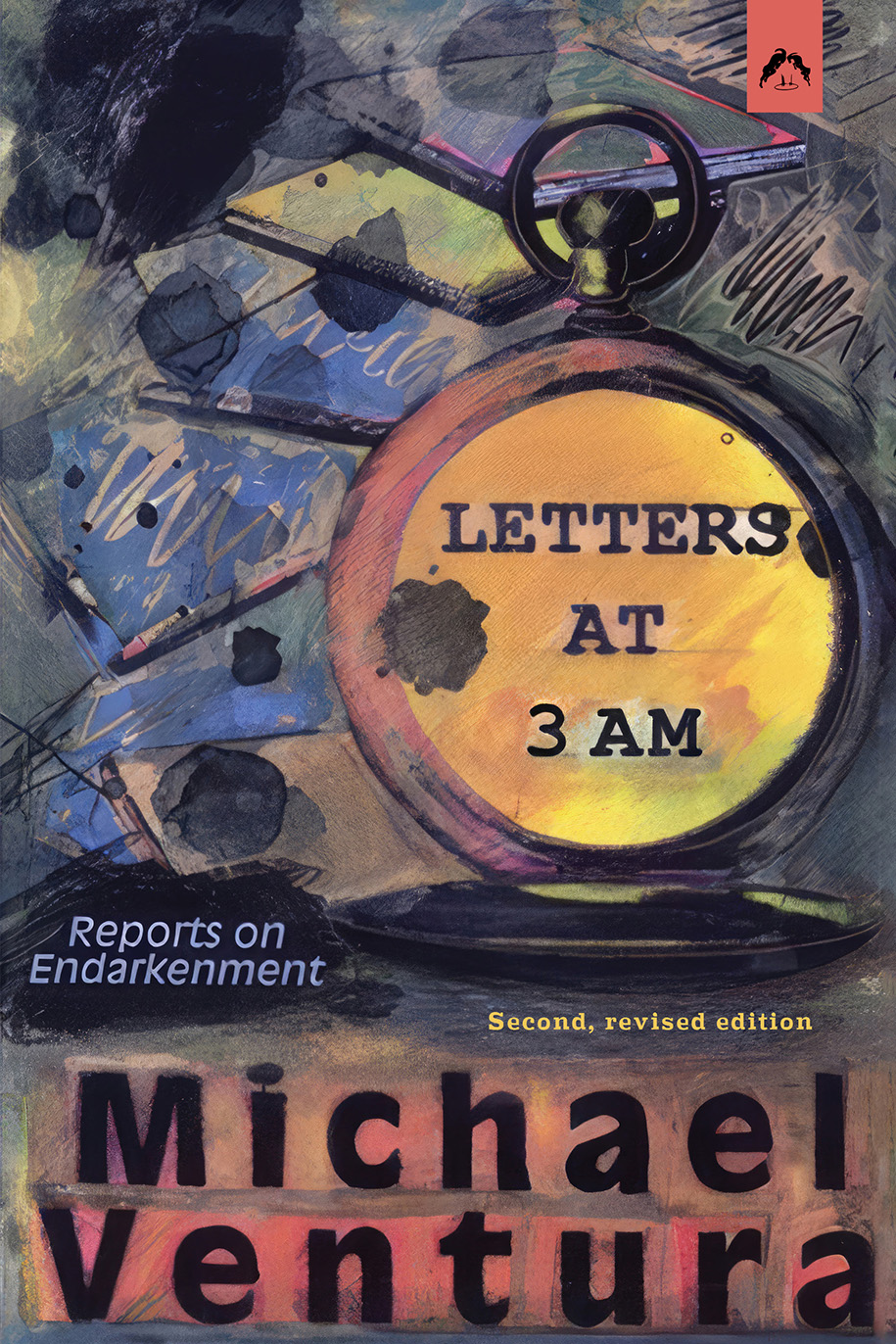
LETTERS AT 3 AM
Reports on Endarkenment
Second, revised edition 2024with a New Introduction by the author Paperback original, 270 pages, $25
ISBN: 978-0-88214-163-3 e-book, $9.99
ISBN: 978-0-88214-164-0
As Ventura writes in his New Introduction: “It’s a good time to remember that, as the essays here attest, this USA is a lively place—a place where, no kidding, the wildest dreams come true. I said ‘wild’ I didn’t say ’good.’ Walt Whitman, Aretha Franklin, atomic bombs, airplanes, smart phones, Buster Keaton, Barbie, Charles Manson, Dolly Parton, MLK, RBG, all kinds of wild … what threatens USA’s Constitution is wild, too, and that Constitution, which never stands still, is innately wild (have you read the Bill of Rights lately?). It is a document oppressors fear. I write these words in the year we’re to prove, beyond a reasonable doubt, whether or not we deserve this USA’s Constitution—or do we have to lose it to realize, deep down, its greatness?”
❝ In “The Age of Endarkenment,” [Ventura] has written the greatest essay yet by a member of his generation.
— Robert Bly Michael Ventura writes with the body and brilliance of someone who lives solidly in this world and yet sees the theater that is invisible to most of us.
— Thomas Moore When I first read Ventura I wept in gratitude for finding my brother in writing. Many people have had this experience.
— Sharon Doubiago